The Panzerfaust: How a Cheap Weapon Changed Tank Warfare
The German Panzerfaust emerged as one of World War II's most consequential infantry anti-tank weapons, forcing a fundamental shift in how armored vehicles operated on the battlefield.
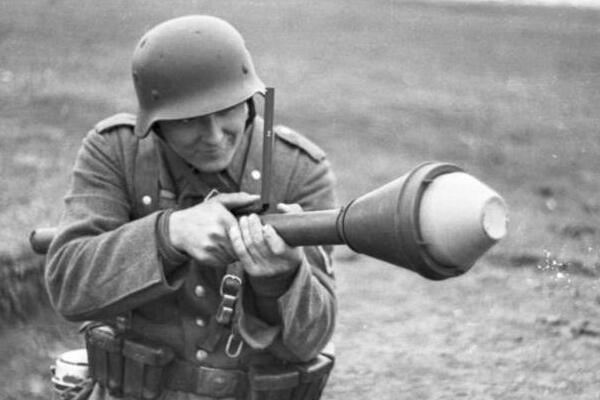
The Panzerfaust, a shoulder-fired, single-use anti-tank weapon developed by Nazi Germany, represented a watershed moment in infantry anti-armor tactics during the Second World War. Its introduction fundamentally altered the tactical calculus of armored warfare in the war’s final years.
The weapon’s appeal lay in its brutal simplicity. Unlike earlier anti-tank rifles or dedicated anti-tank units, the Panzerfaust could be distributed to ordinary infantrymen with minimal training. Each soldier became a potential tank killer. The warhead used a shaped-charge design capable of penetrating the armor of most Allied tanks, including the T-34, Sherman, and even heavy tanks like the IS series. A single hit from relatively close range could achieve a mobility kill or worse.
Germany’s industrial constraints made the Panzerfaust’s low cost and ease of manufacture essential. As the war turned decisively against Nazi forces, the ability to arm masses of troops with anti-tank capability without requiring skilled technicians or extensive logistical support became invaluable. Production ramped up dramatically in the weapon’s final years.
The psychological and operational impact proved significant. When enemy soldiers know that any infantryman in the opposing force might carry a weapon capable of destroying their tank, armored vehicles lose freedom of movement. Tank crews became more cautious. Tanks could no longer operate in loose formations or advance with the reckless confidence that had characterized earlier campaigns. Armored units required closer coordination with dismounted infantry to suppress threats.
Historical records document numerous instances of Panzerfaust strikes destroying or disabling Soviet and American tanks. The weapon proved particularly effective in urban combat and defensive positions, where German troops could ambush advancing armor at close range.
However, the Panzerfaust was not a panacea. Its effectiveness depended heavily on deployment doctrine and tactical opportunity. Despite widespread availability, German infantry struggled to consistently stop Allied mechanized advances as the war drew to a close. The weapon’s range limitations and the courage required to close to effective firing distance meant that poorly trained or demoralized troops could not exploit its potential.
The Panzerfaust’s legacy extended beyond 1945. Its basic concept of a disposable, shoulder-fired shaped-charge weapon directly influenced post-war anti-tank weapon development. The M72 LAW and similar systems owe a conceptual debt to the Panzerfaust’s fundamental design principles. The weapon demonstrated that infantry-portable anti-armor capability, properly distributed and employed, could significantly impact mechanized warfare even when armor maintained overall technological superiority.
← Back to home